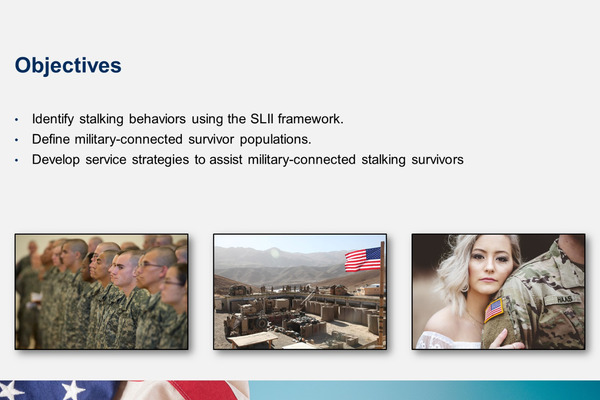
Tácticas invisibles: Apoyo a sobrevivientes de acoso con vínculos militares Los sobrevivientes con vínculos militares experimentan el acoso de maneras que a menudo se ocultan, minimizan o malinterpretan. Esta capacitación básica introduce el marco SLII (Vigilancia, Invasión de la Vida, Intimidación e Interferencia) y explora cómo opera el acoso en entornos militares. Esta sesión sienta las bases para identificar el acoso y comprender su impacto en las personas con vínculos militares. La Organización Nacional para la Defensa de las Víctimas (NOVA) y el Centro de Prevención, Concientización y Recursos sobre el Acoso (SPARC) colaboran para impartir esta capacitación de alta demanda dirigida a defensores comunitarios, fuerzas del orden, personal legal, jueces y profesionales aliados. Military-connected survivors experience stalking in ways that are often hidden, minimized, or misinterpreted. This foundational training introduces the SLII (Surveillance, Life Invasion, Intimidation, Interference) framework and explores how stalking operates within military environments. This session sets the groundwork for identifying stalking and understanding its impact on military-connected individuals. The National Organization for Victim Advocacy (NOVA) and The Stalking Prevention, Awareness, and Resource Center (SPARC) partner to deliver this high-demand training for community advocates, law enforcement, legal personnel, judges, and allied professionals. This project was supported by Grant No.15JOVW-24-GK-03011-MUMU and 15JOVW-22-GK-04039-MUMU awarded by the Office on Violence Against Women, U.S. Department of Justice. The opinions, findings, conclusions, and recommendations expressed in this program are those of the author(s) and do not necessarily reflect the views of the Department of Justice. Read more
Rating
Content
Price

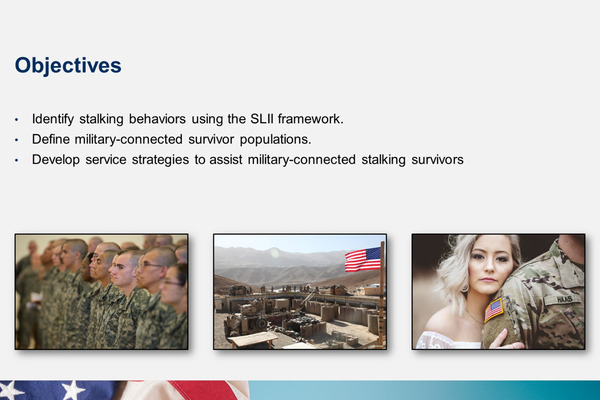
Military-connected survivors experience stalking in ways that are often hidden, minimized, or misinterpreted. This foundational training introduces the SLII (Surveillance, Life Invasion, Intimidation, Interference) framework and explores how stalking operates within military environments. This session sets the groundwork for identifying stalking and understanding its impact on military-connected individuals. This project was supported by Grant No.15JOVW-24-GK-03011-MUMU and 15JOVW-22-GK-04039-MUMU awarded by the Office on Violence Against Women, U.S. Department of Justice. The opinions, findings, conclusions, and recommendations expressed in this program are those of the author(s) and do not necessarily reflect the views of the Department of Justice. Read more
Rating
Content
Price
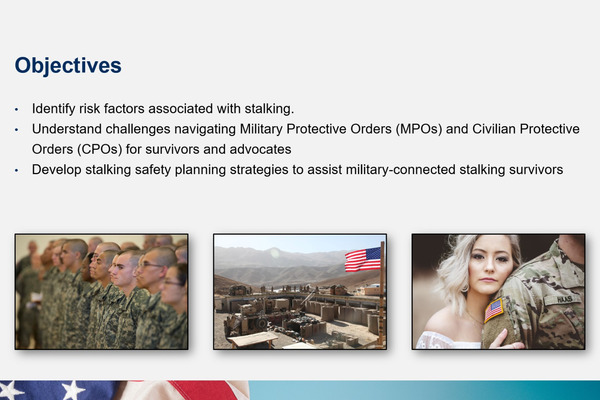
Safety planning with military-connected survivors requires navigating complex systems, limited autonomy, and overlapping jurisdictions. In this session, we’ll examine how to assess risk and create realistic safety plans for survivors living on or off base. Participants will explore the unique barriers survivors face and develop practical strategies grounded in survivor autonomy. Case studies and tip sheets will help anchor learning. This project was supported by Grant No.15JOVW-24-GK-03011-MUMU and 15JOVW-22-GK-04039-MUMU awarded by the Office on Violence Against Women, U.S. Department of Justice. The opinions, findings, conclusions, and recommendations expressed in this program are those of the author(s) and do not necessarily reflect the views of the Department of Justice. Read more
Rating
Content
Price
About This Course: This course provides an introduction to the unique challenges, legal frameworks, and considerations when working with military-connected survivors of domestic violence, dating violence, sexual assault, and stalking (DVSAS). Designed for community advocates, service providers, and legal professionals, the course emphasizes the importance of collaborative Coordinated Community Response (CCR) Teams with military and civilian partnerships to meet the needs of this population. Through expert-led presentations and interactive knowledge checks, participants will develop the skills to collaborate effectively across military and civilian systems, create tailored interventions, and build coordinated responses to support military-connected survivors. This course is developed through the "Advocating for Military-Connected Survivors" project funded by the Department of Justice Office on Violence Against Women. The Project Mission is to provide trauma-informed and survivor-centered training and technical assistance (TTA) that empowers legal personnel, victim advocates, and allied professionals to support military-connected survivors of domestic violence, dating violence, sexual assault, and stalking (DVSAS). If you need support, please contact our team at militarytta@trynova.org. This project is supported by Award No. 15JOVW-22-GK-04039-MUMU awarded by the Office on Violence Against Women. The opinions, findings, and conclusions or recommendations expressed in this publication, conference agenda, or product, are those of the author(s) and do not necessarily reflect the view of the Department of Justice. Read more
Rating
Content
Price

The NOVA Basic Crisis Response Team Training is a 24-hour training pre-approved by the National Advocate Credentialing Program (NACP)® & D-SAACP. The course is designed to provide individuals with a comprehensive overview of NOVA’s Crisis Intervention Model. This CRT Basic training will consist of three days of in-person instruction. To earn a certificate of completion, students must attend ALL live class days and complete the end of class survey. Once you register for this course you will have the opportunity to select from the upcoming sessions you wish to attend. 1) October 28-30, 2026 8:00 am - 5:00 pm Geauga County Administrative Building Chardon, Ohio 44024 Specific Address provided upon registration Registration: NOVA Members - $650 Non-Members - $650 Cancellation/Refund Policy: A full refund minus $65 processing fee is available if cancellation is made at least 24 hours prior to the first day of the session. After this date no refunds will be available. For more information on the course or for assistance registering, please email CRT@trynova.org Read more
Rating
Difficulty
Content
Price
Shopping Cart
Your cart is empty